Wholesale vs DTC: Crafting Your CPG Growth Strategy
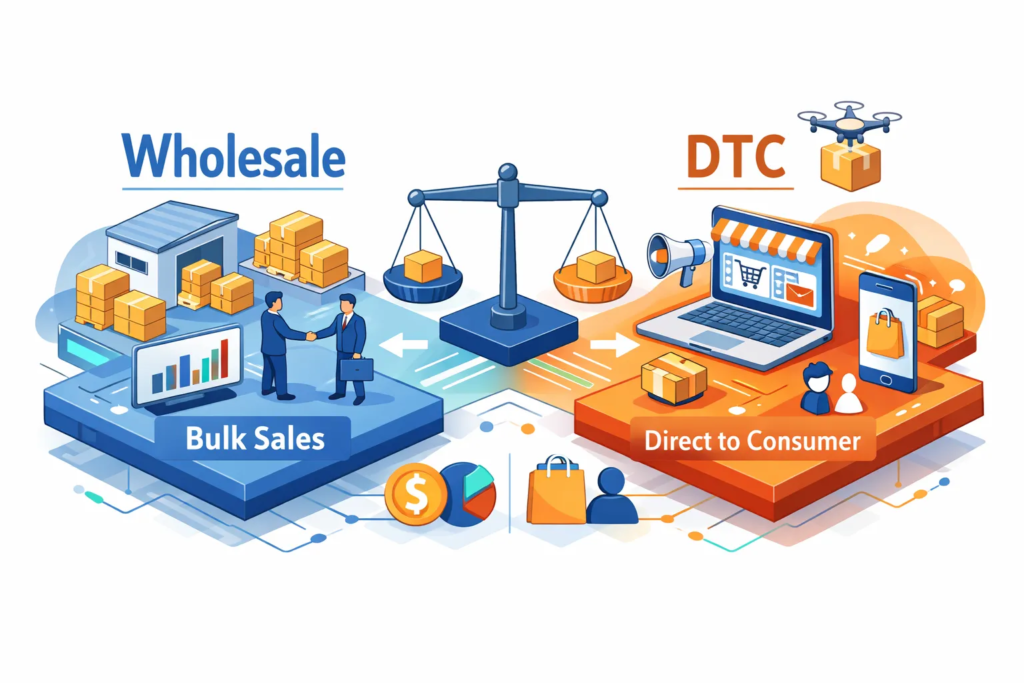
Wholesale is the fastest path to scaled distribution and directly impacts how quickly you hit volume targets. It trades margin for reach: marketplaces and bulk deals get your product into more doors and onto reorder schedules, while trade discounts compress per-unit profit. Below is a framework for balancing wholesale velocity with DTC economics so you capture scale without sacrificing profitability.
By the end, you’ll have rules to protect both channels and a short list of metrics to watch: gross margin by channel, average order value, retail sell-through, days sales outstanding (DSO), and DTC CAC. The following sections present a hybrid strategy you can test in a 90-day sprint.
Key Takeaways
Focus on balancing reach, margins, partner fit, and inventory rules through a short pilot to validate assumptions:
- Channel tradeoff: Wholesale accelerates reach and reorder velocity but lowers per-unit margin. Keep DTC focused on margin, product testing, and first-party data. Use strict channel guardrails to limit cannibalization.
- Price discipline: Adopt a repeatable pricing model (COGS + fulfillment + marketing) to set DTC prices and wholesale floors. This prevents ad-hoc discounting that erodes blended margins.
- Partner selection: Pilot with 1-2 wholesalers or marketplaces. Define clear goals and use a rigorous supplier verification checklist.
- Inventory rules: Choose between a shared inventory pool and channel-reserved stock. Monitor sell-through, AOV, and DSO to catch channel conflicts early.
- 90-day sprint: Run a timeboxed rollout including SKU rationalization, systems integration, and weekly KPI reviews to prove wholesale scale is profitable.
Why a Hybrid Wholesale + DTC Model Wins for CPG
Choosing both channels is a deliberate tradeoff. Wholesale buys reach and predictable reorder velocity, while DTC protects margin and customer data. With clear guardrails, the channels amplify each other rather than compete.
To compare channels, calculate incremental margin per unit by subtracting channel-specific costs from gross profit, then multiply by the additional units expected from wholesale. If the extra volume produces more total contribution margin than DTC at your current CAC, expansion is justified.
Open wholesale when your production and sales collateral are retailer-ready. Define territory limits, SKU splits, and minimum advertised pricing (MAP) upfront. To streamline this process, implement a structured scalable growth plan that uses early metrics like gross margin by channel and repeat rate as decision gates.
Map Your Channel Economics: Margin, Fees, and Unit Costs
Start with a repeatable model so pricing becomes an operational habit. Calculate your unit landed cost (COGS + channel fulfillment + marketing), then derive a target DTC price to hit your desired gross margin.
Make the math explicit:
- MSRP = COGS / (1 − target DTC gross margin)
- Wholesale sell-in price = MSRP × (1 − trade discount)
- Wholesale floor = unit landed cost / (1 − target wholesale margin)
Include platform commissions, payment fees, and amortized MOQ costs (total MOQ expense divided by units). Operationalize this with a three-SKU playbook:
- Hero DTC SKU: Higher margin, 30-45 day reorder cadence.
- Mid Wholesale SKU: Lower COGS, 40% trade discount, 60-90 day cadence.
- Low-cost Sample SKU: Priced to cover MOQ amortization.
Update your channel economics quarterly to protect blended margins.
Choose and Vet Wholesale Partners
Pick 1-2 partners for a tight 60-90 day pilot to limit sourcing risk. Match platforms to your SKU profile: Faire for low MOQs and indie retailers, Shopify B2B (the modern successor to Handshake) for seamless native onboarding, or Wholesale Central for a broad directory approach.
Prioritize suppliers offering native ERP or Shopify APIs to avoid manual order entry. Compare monthly fees, fulfillment SLAs, return policies, and lead times. Vet suppliers rigorously using a supplier verification framework covering:
- Business registration & bank confirmation
- Product certifications (e.g., COAs or HACCP for food/consumables)
- Buyer references
- Paid samples with third-party inspection
Score suppliers on a pass/fail sheet. Once the sample and paperwork clear, move the pilot into fulfillment.
Design Inventory and Fulfillment Rules
Fulfillment dictates whether a hybrid strategy scales. A shared inventory pool maximizes availability but risks retail stockouts during DTC spikes. Conversely, a channel-split approach reserves stock for partners to protect contractual commitments.
Centralize SKU data and automate allocation to set channel-level safety targets, produce lead-time-aware reorders, and enforce rules that prioritize wholesale POs or DTC orders based on business needs. Configure order routing and split-shipment orchestration to lower transit spend and improve delivery certainty.
Run a 30-90 day buffer test with conservative safety stock. Monitor fill rates, then tighten or relax allocations. Translate these rules into contract terms and reorder triggers with partners.
Co-Marketing and Mitigating Channel Conflict
Treat wholesale as a commercial partnership. Provide buyers with line sheets, high-resolution imagery, POS displays, and training guides. Tie co-op advertising credits to minimum sell-through targets—for example, reimbursing 50% of local ad spend up to $2,000 only after documenting 30% sell-through in the first 60 days.
Use tiered trade discounts to reward performance (e.g., higher discounts for launch orders, best terms for bulk replenishment). Keep certain promotions strictly DTC-only to avoid price erosion. Enforce MAP, consider exclusive SKUs, and use geographic territory splits to protect retail relationships.
Implement the Hybrid Plan: The 90-Day Sprint
Run a timeboxed 90-day sprint to force decisions and validate the model quickly:
- Weeks 1-2: Complete SKU rationalization and capacity checks.
- Weeks 3-6: Execute systems integration across Shopify, ERP, and 3PLs.
- Weeks 7-9: Onboard partners and ship targeted retail-ready sample packs.
- Weeks 10-12: Run a 30-day retail sell test, measure actual velocity, and set automatic reorder triggers.
Track a tight KPI set: blended margin, AOV, retail sell-through, days on hand, and inventory turnover. Validate unit economics and reconcile expected margins against scan data before approving a bulk reorder with net terms.
Final Steps to Scale
Channel choice is a manageable tradeoff, not a guess. Assemblage Strategy Group offers operator-led systems sprints that tie Shopify, CRM, ERP, and 3PL into a single revenue engine. Typical integrations run 6-12 weeks, building the allocation rules and automation necessary so wholesale scales without cannibalizing DTC.
Start with a 30-minute channel economics audit: map margin, fees, and unit costs for your top three SKUs in a single spreadsheet. Commit to a weekly pricing review to turn channel complexity into reliable, profitable growth.